
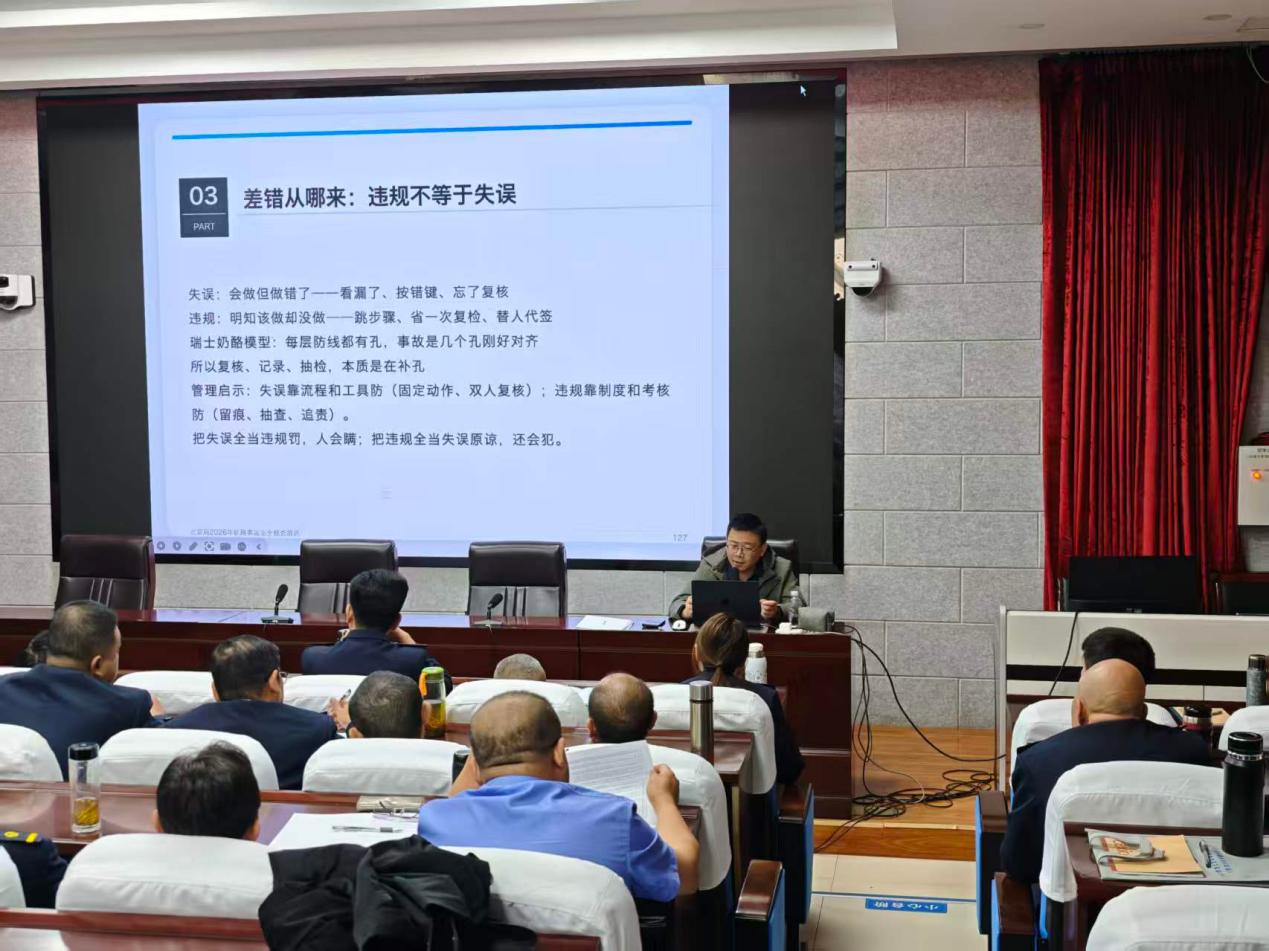
Recently, the 2026 Railway Passenger Transport Safety Inspection Training Course of China Railway Beijing Group Co., Ltd. was held in Shijiazhuang, with more than 40 frontline security inspection personnel from units under the Group participating. Zhao Jinlong, General Manager of Beijing Daoxin Dechen Technology Co., Ltd., was invited to teach.
Recently, the 2026 Railway Passenger Transport Safety Inspection Training Course of China Railway Beijing Group Co., Ltd. was held in Shijiazhuang, with more than 40 frontline security inspection personnel from units under the Group participating. The training focused on the implementation of new regulations and job-specific practical operations, aiming to unify operating standards, address shortcomings in image recognition capabilities, and further strengthen the safety defense line for railway passenger transport.
The training was conducted through a combination of theoretical instruction, physical object comparison, simulated drills, and on-site assessment. Course content included the evolution of railway security inspection systems, laws and regulations and the catalog of prohibited and restricted items, principles and maintenance of security inspection equipment, image recognition methods, on-site handling and record management, and other topics, explaining both "why such regulations exist" and "how to do it on the job."
Zhao Jinlong, General Manager of Beijing Daoxin Dechen Technology Co., Ltd., was invited to teach the course. He began with the forty-year evolution of railway security inspection systems, outlining the progression from the 1994 "Measures for the Inspection and Handling of Dangerous Goods in Railway Passenger Transport (Trial)," the 2005 and 2008 security inspection management measures, to the 2014 Ministry of Transport Order No. 21; he also provided article-by-article interpretation of the newly revised "Public Security Administration Punishments Law" effective January 1, 2026, and national standards such as "Micro-dose X-ray Security Inspection Equipment," reminding trainees to keep regulatory requirements in mind and implement them on the job.
In the equipment and image recognition segment, Zhao Jinlong combined on-site physical objects to explain the working principles, applicable scenarios, and daily maintenance points of X-ray security inspection machines, walk-through metal detectors, handheld metal detectors, handheld explosive detectors, and explosion-proof blankets. Regarding image recognition, he proposed a five-element judgment method of "color, shape, position, association, and common sense," broke down the five fixed steps of image interpretation, and used typical images of detonators, black powder, aerial shells, and unlabeled liquids for comparison, helping trainees move from "seeing" to "judging accurately."
The instruction emphasized a practical orientation. Zhao Jinlong used the five-step closed loop of "discovery—confirmation—handling—recording—review" as the main thread, explaining response methods for three sources of discovery, the four standard actions for bag-opening confirmation, handling choices for four types of situations, and the seven elements that must be fully recorded in logs; he also organized trainees to conduct simulated drills on prohibited item image recognition and bag-opening handling, correcting action details one by one. He emphasized that post-incident accountability depends on logs, not memory; the same type of problem must complete closed-loop rectification within one week, and stressed that "review is not a meeting—it is changing one thing and verifying it does not happen again."
The training required passing both theoretical and practical assessments to graduate. Trainees said that this training translated legal provisions into job actions and confusing images into judgment criteria, especially giving them a clearer grasp of new prohibited item characteristics and log standards; after returning, they will bring the standards they learned to their teams and apply them on the job.
A responsible person from Beijing Group Co., Ltd. stated that security inspection is the first defense line for railway passenger transport safety. In the future, the company will continue to strengthen the security inspection workforce, regularly conduct business training, job skills practice, and skills competitions, promote standardized, normalized, and refined security inspection management, and provide solid safety guarantees for the high-quality development of railways.
As a technology enterprise that has long served the frontline of railway security inspection, Beijing Daoxin Dechen Technology Co., Ltd. will continue to transform frontline pain points into products and courses, deepen research and development in intelligent image judgment, simulation training, and equipment operation and maintenance, and provide technical support for the capacity building of railway security inspection teams.
Want to learn more about DaXinDeChen products and services?
Contact Us →